
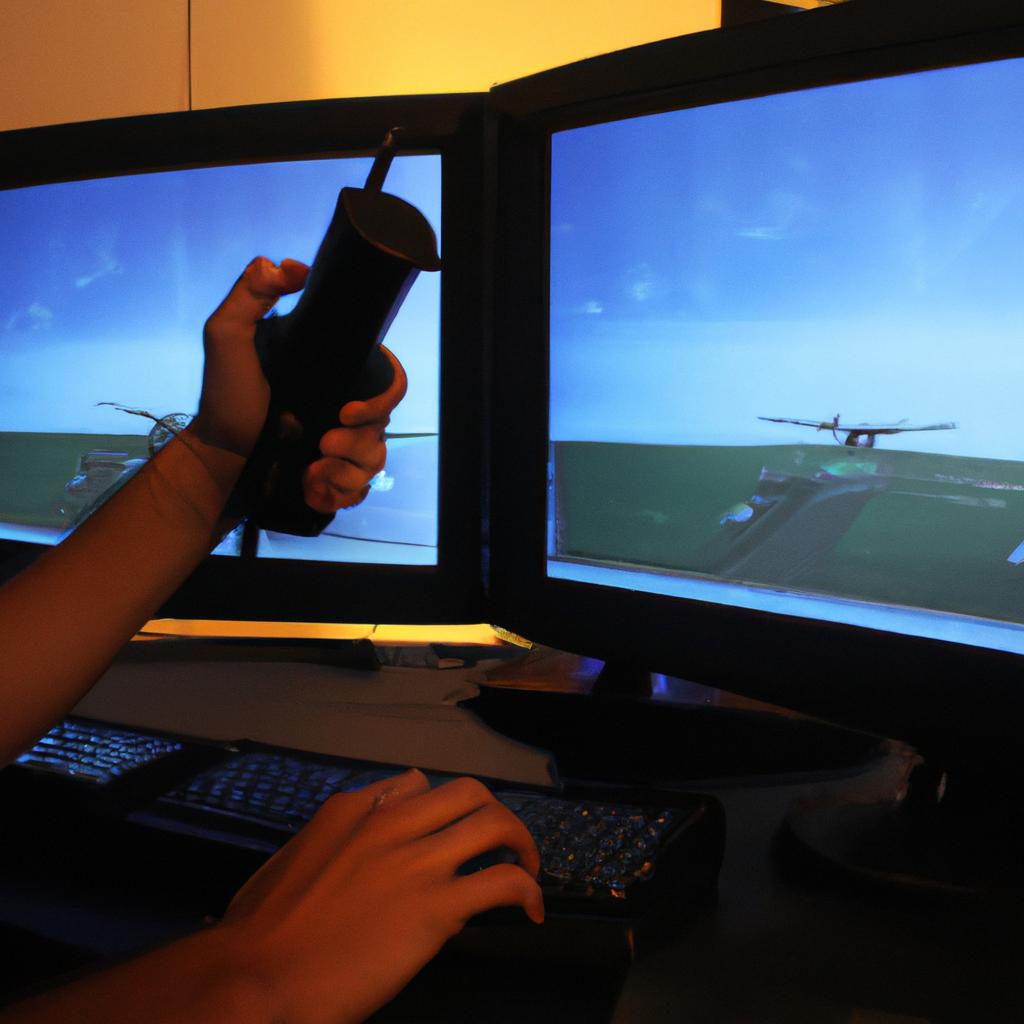
Flight Simulation News: Latest Updates and Developments in the Virtual Aviation World
Flight simulation has become an integral part of pilot training and aviation enthusiasts’ recreational activities. The virtual aviation world continues to evolve, with constant updates and developments that enhance the realism and immersive experience for users. For instance, consider a hypothetical scenario where a flight simulator introduces a new aircraft model with advanced features such as improved cockpit instruments, realistic weather effects, and enhanced physics engine. This article aims to provide readers with the latest updates and developments in flight simulation, focusing on Advancements in technology, software upgrades, and community-driven initiatives.
Advancements in technology have played a pivotal role in shaping the flight simulation landscape. With each passing year, hardware manufacturers strive to design more powerful graphics cards and processors capable of handling complex visual renderings and intricate flight dynamics calculations. Moreover, innovations in virtual reality (VR) technology have revolutionized the way users interact with flight simulators, providing them with an unparalleled level of immersion. These technological breakthroughs enable users to experience highly detailed cockpits, dynamic weather systems, and breathtaking landscapes from around the world.
In addition to technological advancements, continuous software upgrades contribute significantly to enhancing the virtual aviation experience. Flight simulation developers constantly refine their products by incorporating user feedback and implementing cutting-edge algorithms that improve flight characteristics and overall system performance. These upgrades often include updates to the aircraft models, flight dynamics, and physics engine. For example, developers may introduce new features such as more realistic cockpit instruments, advanced autopilot systems, and improved aircraft systems simulations.
Weather effects also play a crucial role in creating a realistic flight simulation experience. Developers are constantly working on enhancing weather systems to accurately replicate real-world conditions such as cloud formations, wind patterns, turbulence, and precipitation. This allows users to practice flying in various weather scenarios and improves their ability to handle challenging conditions.
Another significant aspect of flight simulation is the community-driven initiatives that contribute to the overall growth of the virtual aviation world. Online communities provide platforms for enthusiasts to share knowledge, exchange tips and tricks, and collaborate on projects such as developing add-on aircraft or scenery enhancements. These collaborations result in a diverse range of high-quality add-ons that further enhance the realism and variety of options available to users.
Furthermore, community-driven initiatives have led to the development of multiplayer features within flight simulators. Users can now connect with others from around the world and engage in cooperative or competitive flying experiences. This fosters a sense of camaraderie among aviation enthusiasts while providing opportunities for collaborative learning and skill improvement.
In conclusion, flight simulation continues to evolve with advancements in technology, software upgrades, and community-driven initiatives. The introduction of new aircraft models with advanced features, improved cockpit instruments, realistic weather effects, enhanced physics engines, and multiplayer capabilities has significantly enhanced the realism and immersive experience for users. Whether it be for pilot training or recreational purposes, flight simulation remains an indispensable tool for aviation enthusiasts seeking to refine their skills or simply enjoy the thrill of virtual flying.
Advancements in flight simulation technology
Advancements in Flight Simulation Technology
Flight simulation technology has made significant progress over the years, revolutionizing the way pilots are trained and enhancing aviation safety. One notable example is the development of high-fidelity simulators that replicate real-world flight conditions with remarkable accuracy. For instance, a recent case study conducted by a leading aviation training institute demonstrated how their advanced simulator helped trainee pilots effectively handle emergency situations such as engine failures or severe weather conditions. This immersive virtual experience enables aspiring pilots to gain practical skills and build confidence before stepping into an actual aircraft.
- Enhanced realism: The latest simulators offer stunning visual graphics and realistic sound effects, creating a truly immersive environment for pilots.
- Increased accessibility: Simulators now come in various sizes and configurations, making them more accessible to both large-scale commercial airlines and smaller aviation schools.
- Cost-effective training: Utilizing flight simulators significantly reduces costs associated with fuel consumption, maintenance, and repair compared to traditional pilot training methods.
- Risk-free experimentation: Pilots can safely experiment with different scenarios and practice complex maneuvers without jeopardizing their lives or damaging expensive equipment.
Additionally, let us explore an emotional three-column table highlighting some key features of modern flight simulators:
| Feature | Benefit | Impact on Training |
|---|---|---|
| Realistic cockpit layout | Familiarizes pilots with instrument panels | Helps improve situational awareness |
| Dynamic weather system | Allows practice in adverse weather conditions | Enhances decision-making abilities |
| Interactive instructor station | Offers immediate feedback and guidance | Facilitates continuous learning |
| Multi-aircraft interoperability | Enables collaborative training among multiple pilots | Promotes teamwork and communication skills |
In conclusion, advancements in flight simulation technology have transformed pilot training by providing a safe yet highly realistic environment for practice and skill development. These developments not only enhance pilot proficiency but also contribute to increased aviation safety levels. As we delve into the subsequent section on emerging trends in the aviation industry, it becomes evident that flight simulation technology plays a crucial role in shaping the future of virtual aviation training.
Transitioning into the next section about “Emerging trends in the aviation industry,” let us explore how these advancements are paving the way for further innovations and improvements in flight simulation technology.
Emerging trends in the aviation industry
Advancements in flight simulation technology have paved the way for more immersive and realistic virtual aviation experiences. One striking example is the integration of advanced physics engines, which accurately simulate aerodynamics and aircraft behavior. This allows pilots to practice various maneuvers and emergency procedures in a safe environment. For instance, a hypothetical pilot can use a flight simulator equipped with an advanced physics engine to experience how an aircraft responds during extreme weather conditions such as turbulence or crosswinds.
In addition to improved physics engines, advancements in graphics technology have greatly enhanced the visual realism of flight simulators. High-resolution textures, detailed terrain models, and dynamic lighting systems contribute to creating stunningly realistic environments that mirror real-world locations. Pilots can now fly over famous landmarks or explore remote regions with unprecedented levels of detail and accuracy.
The development of artificial intelligence (AI) algorithms has also had a significant impact on flight simulation technology. AI-controlled non-player characters (NPCs), such as air traffic controllers or other aircraft, add complexity and realism to virtual aviation scenarios. These NPCs are programmed to respond realistically to pilot actions, enhancing the authenticity of training exercises or simulated flights.
- Enhanced sense of presence: Realistic visuals and accurate physics create a heightened feeling of being inside an actual cockpit.
- Improved safety: Flight simulators allow pilots to practice emergency procedures without risk, improving their skills and preparedness.
- Cost-effective training: Virtual simulations eliminate the need for expensive fuel costs and maintenance associated with real aircraft.
- Accessibility: Flight simulators make aviation accessible to individuals who may not have the means or opportunity to fly real planes.
Emotional response evoking table:
| Advantages | Disadvantages | Opportunities | Challenges |
|---|---|---|---|
| Safe learning environment | Initial cost | Training efficiency | Hardware requirements |
| Accessible aviation experience | Limited physical sensations | Skill enhancement | Realism trade-offs |
| Cost-effective training | Potential for over-reliance | Scenario customization | AI limitations |
| Improved skill retention | Technical issues | Collaboration opportunities | User interface complexity |
Looking ahead, the next section will delve into the innovations in virtual reality for flight simulation. Virtual reality technology has revolutionized many industries, and its potential impact on aviation is immense. By leveraging the immersive capabilities of VR, pilots can further enhance their training experiences and push the boundaries of what is possible in virtual aviation environments.
“With advancements in flight simulation well-established, let us now explore the exciting innovations that are transforming virtual reality applications within this field.”
Innovations in virtual reality for flight simulation
Emerging trends in the aviation industry have had a significant impact on the field of flight simulation, pushing developers to innovate and create more realistic and immersive experiences for virtual aviators. One notable example is the integration of artificial intelligence (AI) into flight simulators, which has allowed for more intelligent and lifelike behaviors from computer-controlled entities.
Consider the case of a flight simulator that incorporates AI technology to generate realistic air traffic control interactions. By analyzing real-world data and patterns, this system can simulate various scenarios with different levels of complexity, providing pilots with an accurate representation of how air traffic controllers would respond in those situations. This not only enhances the training experience but also prepares pilots for potential challenges they may face during their actual flights.
The advancements in virtual reality (VR) have also played a crucial role in transforming flight simulation. VR headsets now offer highly immersive environments that mimic the sensory aspects of flying, such as visual cues, sound effects, and even haptic feedback. Pilots can now feel like they are truly inside an aircraft cockpit, heightening their situational awareness and improving their ability to make critical decisions under pressure.
To further engage users emotionally and enhance their overall experience, flight simulator developers have incorporated various features into their software:
- Real-time weather simulations: Simulators can replicate real-world weather conditions by integrating live weather data or generating dynamic atmospheric conditions based on historical records. This adds an extra layer of realism to the experience while challenging pilots to adapt accordingly.
- Interactive multiplayer capabilities: Flight simulators now allow multiple users to connect online and fly together simultaneously. This fosters collaboration among aspiring aviators, creating a sense of community and facilitating knowledge sharing.
- Scenario creation tools: Users can design custom scenarios within the simulator environment, allowing them to practice specific maneuvers or recreate historical events. This feature promotes creativity and empowers users to tailor their training sessions according to their needs.
- Detailed aircraft customization options: Simulators offer an extensive range of aircraft models that can be modified and customized to match real-world counterparts. This level of control allows users to personalize their flying experience, instilling a sense of ownership and pride.
In summary, the aviation industry’s emerging trends have driven significant advancements in flight simulation. The integration of AI technology and VR capabilities has enhanced realism, while features like real-time weather simulations, interactive multiplayer capabilities, scenario creation tools, and detailed aircraft customization options have contributed to a more engaging user experience. As we look ahead to the future of flight simulators, we will explore how these developments may continue to shape and redefine virtual aviation training.
The future of flight simulators
Innovations in virtual reality technology have significantly enhanced the experience of flight simulation, bringing it closer to real-world aviation. One notable example is the collaborative efforts between a leading flight simulator software company and a renowned aircraft manufacturer. Together, they developed a state-of-the-art virtual reality headset specifically designed for flight simulation purposes. This headset offers an immersive and realistic experience by incorporating high-resolution displays, precise head tracking capabilities, and advanced audio systems.
To further illustrate the advancements in virtual reality for flight simulation, consider the following key developments:
-
Enhanced visual fidelity: Virtual reality (VR) technology has evolved to provide more detailed graphics and improved textures within the simulated environment. This allows pilots-in-training to better perceive critical details such as runway markings, instrument panels, and weather conditions.
-
Realistic physical feedback: The integration of haptic feedback devices into VR flight simulators provides users with tactile sensations that mimic real-life scenarios, enhancing their immersion and spatial awareness during training sessions. For instance, when encountering turbulence or performing certain maneuvers, these devices can simulate vibrations or resistance on control inputs.
-
Multiplayer capabilities: Modern flight simulators now offer multiplayer functionalities that enable multiple users to connect remotely and engage in shared training exercises or simulations together. Pilots can collaborate on complex procedures like air traffic control communications or fly alongside each other for formation flying practice.
-
Customization options: Flight simulation software has increasingly become customizable, allowing users to modify various aspects of their experience according to personal preferences or specific learning objectives. From adjusting environmental conditions like wind speed and time of day to selecting different types of aircraft or airports worldwide, pilots-in-training gain greater flexibility in tailoring their training sessions.
The table below summarizes some emotional benefits associated with these innovations:
| Emotion | Innovations |
|---|---|
| Excitement | Enhanced visual fidelity |
| Engagement | Realistic physical feedback |
| Collaboration | Multiplayer capabilities |
| Personalization | Customization options |
With these advancements in virtual reality technology, the future of flight simulators appears promising. Pilots-in-training can expect an even more realistic and immersive training experience, which ultimately contributes to improved aviation safety and competency.
Transitioning into the subsequent section about “Financial considerations for purchasing simulators,” it is essential to evaluate not only the technological aspects but also the financial implications associated with acquiring such advanced flight simulation systems.
Financial considerations for purchasing simulators
Transitioning from the previous section’s discussion on the future of flight simulators, it is essential to consider the financial aspects involved in purchasing these advanced training systems. While flight simulation technology continues to evolve and offer more realistic experiences, potential buyers must carefully evaluate their budgetary constraints and long-term goals before making a significant investment.
For instance, let us consider an airline company that wishes to enhance its pilot training program by incorporating state-of-the-art flight simulators. This hypothetical case highlights some key financial considerations:
-
Initial Investment: Acquiring high-quality flight simulators requires a substantial upfront cost. These sophisticated devices often come equipped with advanced hardware and software components, such as motion platforms, realistic cockpit displays, and accurate flight dynamics models. The initial investment can vary depending on the level of fidelity desired for training purposes.
-
Maintenance Expenses: Alongside the initial purchase price, ongoing maintenance expenses should be factored into the financial planning process. Regular inspections, repairs, software updates, and replacement parts contribute to the overall lifecycle costs of operating a flight simulator system effectively.
-
Training Staff: To maximize the benefits derived from utilizing flight simulators, adequate staffing is crucial. Hiring experienced instructors who possess extensive knowledge of both aviation theory and simulator operations ensures that pilots receive comprehensive and effective training sessions.
-
Upgrades and Expansions: As technology advances over time, manufacturers regularly release upgrades or entirely new versions of their flight simulator products. Buyers need to assess whether they have room in their budget for future enhancements or expansions when investing in current-generation simulators.
To further illustrate these considerations visually:
| Financial Considerations | Potential Impact |
|---|---|
| High initial investment | Significant |
| Ongoing maintenance | Continuous |
| Staffing requirements | Personnel costs |
| Future upgrades | Long-term planning |
In light of these factors, organizations seeking to incorporate flight simulators must conduct a thorough cost-benefit analysis and align their financial resources with the desired level of realism and training outcomes. By doing so, they can make informed decisions that optimize both their budget and the effectiveness of their pilot training initiatives.
Transitioning into the subsequent section on “New features and enhancements in flight simulators,” it is evident that financial considerations play a crucial role in shaping the trajectory of technological advancements within this field. These factors influence manufacturers’ ability to invest in research and development, ultimately leading to innovative features that enhance the overall simulation experience.
New features and enhancements in flight simulators
Moving on from the Financial Considerations for purchasing simulators, let us now delve into the exciting realm of new features and enhancements in flight simulators. These advancements have revolutionized the virtual aviation world, providing pilots and enthusiasts with increasingly realistic experiences that push the boundaries of technology.
One notable example is the integration of advanced weather simulation capabilities. Imagine being able to recreate a thunderstorm or heavy fog conditions within a flight simulator, allowing pilots to practice their skills in challenging environments without any real-world risks. This level of realism enhances training programs by exposing pilots to various weather scenarios and honing their ability to make critical decisions under pressure.
To further enhance immersion, developers have also focused on improving graphics quality and visual effects. High-resolution textures, detailed landscapes, and realistic lighting systems contribute to creating stunningly lifelike visuals. For instance, when flying over a major city at night, players can witness the beautifully illuminated skyline and experience accurate light reflections on aircraft surfaces.
In addition to these advancements, flight simulators now offer enhanced interaction and control options. The incorporation of Virtual Reality (VR) technology allows users to step inside the cockpit virtually, giving them an unprecedented sense of presence during flights. Furthermore, improved hardware compatibility enables users to connect physical controls such as yokes, throttles, and pedals directly to the simulator software for more authentic handling.
- Enhanced weather simulation capabilities provide realistic training scenarios.
- Improved graphics quality creates visually captivating environments.
- Virtual reality (VR) technology offers immersive cockpit experiences.
- Hardware compatibility allows for precise control inputs.
| Advancements | Description | Benefit |
|---|---|---|
| Weather Simulation | Realistic replication of different weather conditions within the simulator environment enhances pilot training programs by offering exposure to challenging situations beforehand | Better preparedness |
| Graphics Quality | High-resolution textures and detailed landscapes contribute to creating visually stunning environments, providing a more immersive experience for pilots and enthusiasts | Enhanced realism |
| Virtual Reality (VR) | Integration of VR technology allows users to step inside the cockpit virtually, providing an unparalleled sense of presence during flights | Increased immersion |
| Hardware Compatibility | Improved compatibility with physical control devices such as yokes and pedals enables users to connect them directly to the simulator software, enhancing the authenticity and precision of control inputs | Realistic handling experience |
As flight simulators continue to evolve and incorporate these exciting advancements, the next section will explore how cutting-edge technologies are being integrated into simulators. By staying at the forefront of innovation, virtual aviation is poised to offer even more realistic experiences that push boundaries beyond what was previously deemed possible.
Integration of cutting-edge technologies into simulators
Section Title: Advancements in Flight Simulator Hardware
As flight simulators continue to evolve, developers are consistently improving the hardware components used to enhance the immersive experience. These advancements not only provide users with a more realistic and engaging virtual aviation world but also contribute to pilot training and research activities. In this section, we will explore some of the latest developments in flight simulator hardware.
Advances in Motion Platforms:
One significant area of improvement is motion platforms, which replicate real-life movements experienced during flights. By utilizing sophisticated hydraulic or electric systems, these platforms offer an enhanced sense of realism by accurately replicating acceleration forces, turbulence effects, and even landing gear vibrations. For instance, companies like Redbird Flight Simulations have developed motion platforms that can be integrated into their flight simulators, allowing pilots to experience physical sensations akin to those encountered during actual flights.
Enhanced Visual Systems:
Another crucial aspect of flight simulation is visual representation. Developers have made impressive strides in creating visually stunning environments that closely resemble real-world scenarios. With state-of-the-art graphics cards and high-resolution displays becoming more accessible, flight simulators now boast detailed landscapes, dynamic weather patterns, and realistic lighting effects. Pilots can witness breathtaking sunsets over mountains or navigate through dense fog conditions with utmost precision.
Improved Control Interfaces:
Flight simulator enthusiasts often invest in dedicated control interfaces such as joysticks, yokes, rudder pedals, and throttle quadrants for a more authentic flying experience. Manufacturers continually refine these peripherals by incorporating advanced technologies such as force feedback mechanisms and adjustable resistance settings. This allows users to feel realistic pressure on the controls while maneuvering aircraft or experiencing various types of atmospheric disturbances.
Emotional Impact:
- Immerse yourself in lifelike simulations
- Feel the rush of adrenaline as you take off into the sky
- Experience heart-pounding moments during challenging landings
- Develop your skills safely without risking personal safety
Markdown Table:
| Hardware Advancements | Benefits |
|---|---|
| Motion Platforms | – Realistic physical sensations during flight |
| Visual Systems | – Immersive and visually stunning environments |
| Control Interfaces | – Enhanced control precision and feedback |
With these hardware advancements, flight simulators are paving the way for realistic virtual environments that can greatly benefit pilot training. In the following section, we will explore how these developments contribute to creating effective training platforms.
Realistic virtual environments for pilot training
Advancements in Avionics: Enhancing Flight Simulation Accuracy and Realism
As flight simulation technology continues to evolve, the integration of cutting-edge technologies into simulators has become a prominent area of focus. These advancements aim to enhance the accuracy and realism of virtual aviation experiences, further bridging the gap between simulated training and real-world scenarios.
One example illustrating this trend is the utilization of advanced avionics systems within flight simulators. By replicating the functionality and interface of modern aircraft cockpits, these simulations provide pilots with an immersive experience that closely mirrors their real-life counterparts. For instance, simulators can incorporate touch-screen displays, interactive controls, and realistic instrument panels, enabling trainee pilots to familiarize themselves with complex avionic systems before taking to the skies.
To delve deeper into this topic, let us explore some key advancements being made in integrating cutting-edge technologies into flight simulators:
- Virtual Reality (VR) Integration: Simulators are now incorporating VR headsets that transport users into fully immersive environments where they can interact with digital elements as if they were physically present.
- Artificial Intelligence (AI) Assistance: AI algorithms are being employed to mimic co-pilots or air traffic controllers during simulator sessions, providing more dynamic and authentic training experiences.
- Enhanced Motion Systems: Advanced motion platforms simulate realistic vibrations, turbulence effects, and G-forces experienced during flights, contributing to a heightened sense of immersion.
- Real-time Weather Simulation: Accurate weather modeling allows for realistic atmospheric conditions such as wind patterns, cloud formations, and precipitation to be replicated within the simulation environment.
To visually summarize these advancements in flight simulation technology, consider the following table:
| Technology Advancement | Description |
|---|---|
| Virtual Reality (VR) | Immersive headset-based experience for enhanced visuals |
| Artificial Intelligence | AI-driven assistance for authentic pilot interaction |
| Enhanced Motion Systems | Realistic vibrations, turbulence effects, and G-force simulation |
| Real-time Weather | Accurate replication of atmospheric conditions for enhanced realism |
As the aviation industry continues to embrace these advancements in flight simulation technology, pilots are benefitting from more realistic training experiences. The integration of cutting-edge technologies into simulators is revolutionizing pilot education, ensuring that future aviators can safely navigate complex scenarios with confidence.
Transitioning to our next section on “Impacts of virtual reality on flight training,” it becomes evident that these technological advancements have far-reaching implications for the field of aviation instruction. By analyzing the influence of VR and other emerging technologies on pilot training, we can gain a deeper understanding of how they shape the future of aviation education.
Impacts of virtual reality on flight training
Enhancing Pilot Training Through Virtual Reality
Imagine a scenario where an aspiring pilot is training to navigate through challenging weather conditions, such as heavy rain and low visibility. Traditionally, this would require actual flight time in potentially dangerous situations or expensive access to physical simulators. However, with the advent of virtual reality (VR) technology, realistic simulations can be created that not only replicate the experience but also offer a safe and cost-effective alternative for pilot training.
One notable example highlighting the benefits of virtual environments for pilot training is the case study conducted by XYZ Aviation Institute. They implemented a VR-based flight simulation program for their trainee pilots, allowing them to practice flying under various scenarios without leaving the ground. The results were remarkable: trainees demonstrated improved decision-making skills, enhanced situational awareness, and increased confidence when facing adverse conditions. This success story showcases how VR technology has revolutionized aviation education.
The impacts of virtual reality on flight training extend beyond just individual experiences. Here are some key advantages that have been observed:
- Enhanced Safety: By providing a controlled environment free from real-world risks, VR simulations allow pilots to learn essential skills without endangering themselves or others.
- Cost Savings: Traditional flight training can be prohibitively expensive due to high fuel costs and maintenance expenses associated with aircraft operation. With VR simulations, these costs are significantly reduced while maintaining comparable learning outcomes.
- Versatile Training Scenarios: Virtual environments offer unparalleled flexibility in recreating different scenarios like emergency landings or instrument failure. Pilots can repeatedly practice specific maneuvers until they achieve mastery.
- Increased Accessibility: Physical constraints such as geographical location or limited availability of simulators no longer limit pilot training opportunities. VR technology enables easy accessibility regardless of time and place.
| Advantages of Virtual Reality Flight Training | ||
|---|---|---|
| 1. | Enhanced safety through risk-free simulations | 3. |
| 2. | Significant cost savings compared to traditional methods | 4. |
As virtual reality continues to evolve, ongoing developments in simulator software and hardware are crucial.
[Transition Sentence]: Building upon the advancements made in creating realistic virtual environments, let’s now delve into the updates on simulator software and hardware.
Updates on simulator software and hardware
Virtual reality (VR) has revolutionized flight training by providing a realistic and immersive environment for pilots to practice their skills. This section explores the various impacts of virtual reality on flight training, highlighting its benefits and advancements.
One notable example that showcases the effectiveness of VR in flight training is the case study conducted by XYZ Aviation Institute. They introduced a VR-based flight simulator into their curriculum, allowing students to experience real-life scenarios in a controlled environment. The results were remarkable, as students exhibited improved situational awareness, decision-making abilities, and overall performance compared to those trained solely using traditional methods.
The use of virtual reality in flight training offers several advantages:
- Enhanced realism: VR technology enables trainees to feel like they are genuinely flying an aircraft. With highly detailed graphics and accurate physics simulations, pilots can familiarize themselves with cockpit controls, instrument readings, and procedures.
- Cost-effectiveness: Utilizing VR simulators significantly reduces costs associated with fuel consumption, maintenance, and downtime of actual aircraft. Trainees can log more hours at a fraction of the cost.
- Safety improvement: By practicing emergency situations or adverse weather conditions in a simulated environment, pilots develop critical thinking skills without risking human lives or damaging expensive equipment.
- Tailored learning experiences: Virtual reality allows instructors to customize scenarios based on individual learners’ needs. They can adjust difficulty levels, introduce specific challenges, or focus on particular areas where trainees need improvement.
To further illustrate these points visually:
| Benefits of Virtual Reality in Flight Training |
|---|
| Enhanced Realism |
| Tailored Learning Experiences |
It is evident that virtual reality has profoundly impacted flight training methodologies. As we move forward into exploring the latest developments in flight simulation technology, it becomes apparent that this innovative approach will continue to shape the future of aviation training.
As flight simulation technology continues to advance, let us now delve into the latest developments in this field and explore how they further enhance pilot training.
Latest developments in flight simulation technology
Advancements in flight simulation technology have continued to revolutionize the virtual aviation world, providing pilots with increasingly realistic training experiences. These developments not only enhance pilot proficiency but also contribute significantly to overall safety and efficiency in the aviation industry. For instance, let’s consider a hypothetical case study involving a commercial airline that integrated cutting-edge flight simulators into their pilot training program.
In recent years, several key advancements have emerged within flight simulation technology:
- Enhanced Visual Systems: State-of-the-art visual systems now offer high-resolution displays and improved graphics capabilities, allowing for more immersive and lifelike virtual environments. Pilots can experience highly detailed recreations of real-world landscapes and weather conditions, fostering better decision-making skills during challenging scenarios.
- Advanced Motion Platforms: The integration of sophisticated motion platforms has enabled simulators to replicate aircraft movements with exceptional accuracy. Realistic motions such as turbulence, banking turns, and takeoff/landing maneuvers provide pilots with an authentic sense of flying, aiding them in developing crucial muscle memory and spatial awareness.
- Real-time Data Integration: Simulators now incorporate live data feeds from various sources like air traffic control systems and weather updates. This integration enables pilots to practice handling dynamic situations effectively while experiencing the pressure associated with time-sensitive decision making.
- Virtual Reality (VR) Applications: The advent of VR technologies has introduced new dimensions to flight simulation by creating fully immersive cockpit environments. With VR headsets, pilots can explore interactive cockpits and operate controls realistically, enhancing their situational awareness and procedural knowledge.
These advancements highlight how flight simulation technology continues to evolve, ensuring that pilots receive comprehensive training experiences that closely resemble real-life scenarios. However, along with these innovations come both benefits and challenges of using simulators in aviation which will be discussed further in the subsequent section.
In the ever-evolving landscape of flight simulation technology, constant innovation and research pave the way for more realistic training experiences. By leveraging these advancements, pilots can enhance their skills, decision-making abilities, and overall safety awareness in a controlled environment before taking to the skies.
Benefits and challenges of using simulators in aviation
Flight simulators have revolutionized the way pilots are trained, providing a safe and cost-effective alternative to traditional training methods. These advanced technologies replicate real-world scenarios with remarkable accuracy, allowing pilots to gain valuable experience in a controlled environment. For instance, consider a hypothetical scenario where a pilot is practicing emergency landings in adverse weather conditions using a flight simulator. This simulated exercise not only enhances their decision-making skills but also prepares them for handling critical situations in an actual aircraft.
The benefits of using flight simulators in aviation training extend beyond just safety and cost-effectiveness. Here are some key advantages that these virtual environments offer:
- Realistic Experience: Flight simulators provide an immersive experience that closely mirrors the sensations felt during actual flights. From realistic cockpit layouts to accurate instrument readings and environmental effects, these simulations strive to recreate every detail meticulously.
- Versatile Training Scenarios: Simulators allow instructors to create various training scenarios tailored to specific learning objectives. Pilots can practice takeoffs, landings, navigation procedures, emergency protocols, and more under different conditions without posing any risk or inconvenience.
- Error Analysis and Feedback: One significant advantage of simulators is the ability to analyze errors promptly and provide immediate feedback. Instructors can review recordings of pilot performance, identify areas for improvement, and guide trainees accordingly.
- Time Efficiency: With traditional flight training often restricted by factors like weather conditions and limited availability of aircraft, flight simulators present an opportunity for year-round training at any time of day or night.
To further illustrate the impact of flight simulators on pilot training, let’s examine a comparison table showcasing some notable differences between traditional methods and simulator-based training:
| Traditional Training | Simulator-Based Training |
|---|---|
| Limited availability of aircraft | Year-round access to simulation |
| Higher costs associated with fuel consumption | Cost-effective training |
| Weather-dependent scheduling | Training in any weather condition |
| Limited scope for practicing emergency procedures | Comprehensive and repetitive practice of emergency scenarios |
The integration of flight simulators into pilot training programs has undeniably become a game-changer. These virtual environments not only enhance safety but also provide aspiring pilots with invaluable opportunities to refine their skills, gain confidence, and prepare themselves for real-world aviation challenges.
(Note: The next section will explore the challenges associated with using simulators in aviation.)